Why Are Trump Supporters So Incredibly Loyal?

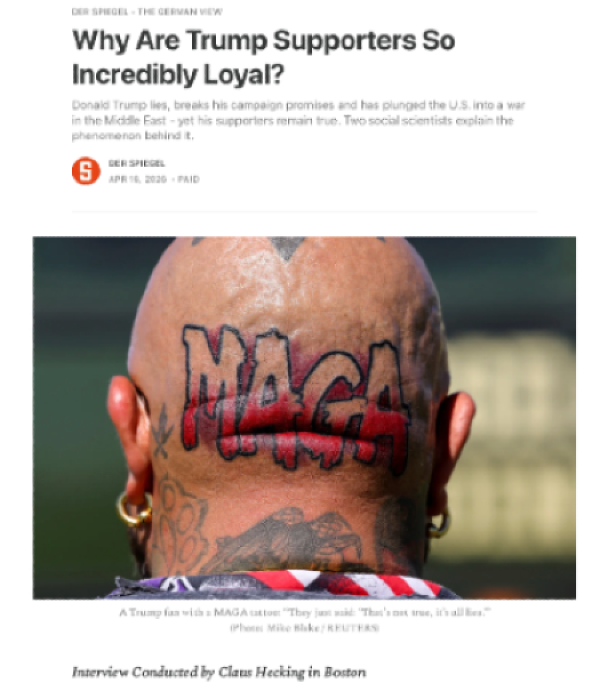
Donald Trump lies, breaks his campaign promises and has plunged the U.S. into a war in the Middle East - yet his supporters remain true.
Rather than going to a diner in Iowa to speak with Trump voters like the NY Times does every few months, two social scientists actually did some research. Here's my take on the article in Der Spiegel's newsletter with those two scientists. I've pasted some of the interview below and there's a link to the original article.
Why do millions remain fiercely loyal to a political figure whose actions often contradict his own promises and materially harm many of those same supporters?
That question cannot be answered by surface-level explanations about policy or personality alone. It sits at the intersection of psychology, power, prejudice, identity, and the deeper systems that shape how people interpret reality itself.
Loyalty to Donald Trump is not simply about agreement with his policies. It is about commitment, emotional investment, and identity formation. Once people publicly align themselves with a leader, attend rallies, spend money, defend him in conversations, or build community around that support, walking away is no longer just a political shift. It becomes a rupture of self.
Psychological processes like cognitive dissonance help explain how individuals resolve the tension between conflicting realities and prior commitments, often by rejecting new information rather than re-evaluating their beliefs. This dynamic is reinforced by confirmation bias, the tendency to seek out, believe, and prioritize information that aligns with existing views while dismissing contradictory evidence, allowing supporters to continuously validate their loyalty even when faced with opposing facts.
But psychology alone is not enough.
This loyalty is also produced within a broader media ecosystem that repeats narratives, redirects attention, and reinforces a shared worldview. Repetition shapes belief. Collective identity strengthens attachment. And political messaging that activates fear, grievance, and perceived cultural loss creates conditions where loyalty becomes defensive, even when contradictions are visible.
There is also a deeper layer tied to power. Political movements do not emerge in a vacuum. They draw from existing social hierarchies, economic anxieties, and long-standing narratives about who belongs, who is losing status, and who is to blame. In this context, Trump does not just function as a politician. He becomes a symbol, a vessel through which people process anger, fear, and identity.
The research these scientists present moves beyond the question of “why do they support him” to examine how loyalty is built, maintained, and protected, even in the face of contradiction. It explores the psychological mechanisms, social structures, and power dynamics that turn political support into something far more enduring and difficult to break.
NOTE: I get the daily newsletter from Der Spiegel to get a perspective on the news from Germany. Full disclosure, also because my wife, Alia, is German and I want to see what's happening there and get their take on what's happening here.
Read the full article at the Spiegel newsletter
DER SPIEGEL: Ms. Harmon-Jones, Mr. Harmon-Jones, Donald Trump has gone from being a self-declared peacemaker to a president who doesn’t shy away from deploying the U.S. military on operations and starting wars. He also promised to cut energy prices in half and to lower the cost of living – and has thus far done the opposite. Nevertheless, around 40 percent of Americans still stand behind him. Why are Trump’s supporters so loyal?
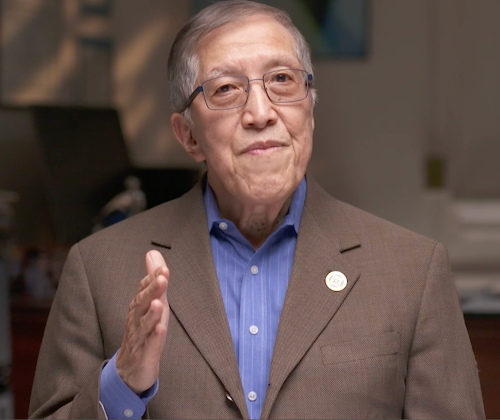
Cindy Harmon-Jones: That’s something we were already asking ourselves during Trump’s first term. We couldn’t understand why people were so loyal to him even when they were personally suffering under his policies. Because we had both been working on cognitive dissonance for a long time, we tried to use that framework to find some answers. We conducted three studies with a total of 700 Trump supporters and examined whether new information changes their attitudes toward him.
DER SPIEGEL: What is cognitive dissonance?
Eddie Harmon-Jones: We humans are constantly making decisions, whether it’s choosing between refrigerator A or refrigerator B, voting for a politician or joining a movement. Once we’ve made a decision, our psyche is essentially programmed to stick with it. We justify our decisions after the fact by unconsciously inflating the benefits of the option we chose and discounting the benefits of the one we didn’t.
DER SPIEGEL: And how does that explain loyalty to Trump?
Cindy Harmon-Jones: When we hold two perceptions, beliefs or pieces of information that contradict each other, we feel uncomfortable. For example, the attitude “I support Trump” runs up against the information “Trump has behaved illegally and immorally.” So we try to resolve that conflict, often by downgrading the new information so that it fits better with our existing attitude. But this process can lead us astray – if we made a wrong assumption at the start and then discount the new, accurate information. What we should do instead is say: “I was wrong at the beginning, and I need to adjust my behavior and my thinking to match reality.”
DER SPIEGEL: Do Trump supporters adjust to reality?
Eddie Harmon-Jones: Barely. In our studies, we presented participants with information that was incompatible with their view of Trump – things like his sexual assaults on women, or his role in the storming of the Capitol on January 6, 2021. Most of them simply denied the accuracy of the information. They just said: “That’s not true, it’s all lies.”
Cindy Harmon-Jones: Others claimed that other politicians are no better. Some said they only cared about what Trump did as a politician, not about his personal conduct. And some said the information simply didn’t matter to them. A few even mixed multiple justifications together. They said the new information was lies, and also that other politicians do the same things. That contradiction shows just how strong their desire to justify was.
DER SPIEGEL: Did no one express any criticism of Trump or turn away from him?
Cindy Harmon-Jones: Only in our final study – which was conducted after the Capitol attack at a time when our democracy was directly under assault and Trump was later indicted – did a small number of participants say something like: “I voted for him, I supported him. But that was not okay, and I don’t support him anymore.” But even then, it was only 13 percent.
Eddie Harmon-Jones: Trump is a master at creating bonds and at getting people to commit themselves to him.
DER SPIEGEL: How is he able to do that?
Eddie Harmon-Jones: Our research shows that it’s not just conflicting beliefs that generate dissonance, it’s primarily the actions we’ve already taken. Meaning: Once you’ve done something concrete to support Trump, it becomes especially hard to walk away from him.
DER SPIEGEL: Things like attending a Trump rally?
Eddie Harmon-Jones: Or buying yourself a red MAGA cap. Researchers call this commitment: You pledge yourself to something, you invest time or money in it. If you later walk away, that investment is lost.
DER SPIEGEL: What about vilifying political adversaries and diversionary tactics? What role do they play?
Cindy Harmon-Jones: A major one. Especially in critical moments for Trump, the pro-Trump media ecosystem, both social and traditional, constantly shifts the conversation to other topics …
Eddie Harmon-Jones: … like stories about transgender women in sports, which reliably gets the base riled up.
Cindy Harmon-Jones: And they’re remarkably homogeneous, whether it’s Fox News, right-wing radio, or the influencers. They often cover the same topics in parallel and take the same positions. You can see this happen in real-time when a new event takes place: At first they say different things, but over a short period of time, they all get on the same page and parrot the same points. Someone who watches Fox before listening to these podcasters and influencers gets the exact same story, over and over.
DER SPIEGEL: Doesn’t that get boring?
Cindy Harmon-Jones: On the contrary. Scientific experiments have shown: If you tell people a lie and keep repeating it, many of them will start to believe it after enough repetitions. Even if you told them in advance that it was a lie.
DER SPIEGEL: Trump repeats himself constantly.
Eddie Harmon-Jones: Some people think that’s because he has dementia. More likely, he’s repeating himself quite deliberately. So it sticks.
Read the original post here: Why Are Trump Supporters So Incredibly Loyal?