When you speak truth, it's not a rant

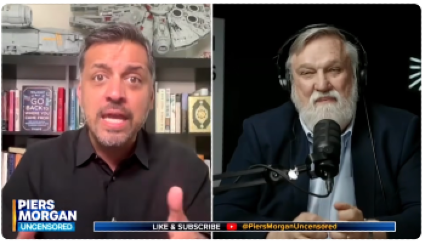
Last night Wajahat Ali showed up on the Piers Morgan show to debate the failures of Trump's Iran War and Trump's inexplicable fight with Pope Leo. I have added an 8 minute clip below in which Ali confronted Pastor Doug Wilson, who is the religious mentor of Secretary of Defense Pete Hegseth and has a history of cruelty, racism, and misogyny. As you'll see, Waj brought the receipts.
What Wajahat Ali did was not a rant. It was a reckoning. And every word was receipted.
Wajahat Ali did not raise his voice to perform anger. He raised it because the receipts were already in his hands. He named Wilson not as a provocateur but as a documented architect of pro-slavery theology, anti-democratic Christian nationalism, and cosplay militarism with real body counts. He didn't debate. He catalogued.
Each charge was a fact, each fact was a verdict, and the verdict was delivered without apology and without the performance of balance. Then, at the end, he didn't reach for rage. He reached for scripture. And that is what made it devastating.
About Wajahat Ali
Wajahat Ali is a well-known truth-speaker. He's writer, recovering attorney, author, and tired dad of 3 kids who now drives a Honda Odyssey Minivan and shops at Costco. Everyone knows him as Waj and he edits The Left Hook Substack and his website is here.
Why Waj's Model of Using his Platform Matters
What Waj did matters because the threat is not abstract anymore. It has Crusader tattoos and Pentagon clearance. Christian nationalism is white nationalism with a cross on top. It is not a fringe theology. It is a governance project, and right now it controls the United States Department of Defense.
When someone with a platform calls out the racism and bigotry directly, on camera, to to the face of the ideology itself, with receipts, it breaks the performance of legitimacy that Christian nationalism requires to expand. These men need debate partners, not interrogators.
Waj refused to be a debate partner. He walked in as a witness, named the harm, named the ideology, and named the Jesus these men have abandoned.
That is the model. Not politeness. Not both-sides. Not "I understand your perspective but." Just: here is what you wrote, here is what it costs, here is what you actually believe, and here is what it is doing to real people right now.
The danger is that religious zealotry leads people to approve of things and engage in behavior that they would not otherwise, in the service of God, ironically overriding basic personal morality and creating the space for a shift in national beliefs about what is right versus wrong.
And let's be clear - platform holders who stay neutral on that are not being careful. They are being useful to the project. They are complicit.
About Doug Wilson
Doug Wilson is the bigoted religious mentor of Secretary of War Pete Hegseth, the under-qualified former Fox host with Cosplay Crusader tattoos all over his body. Wilson doesn't believe in the 19th Amendment or the separation of Church and State, and he has written that American slavery was "mutually harmonious" for both the slave masters and enslaved people.
During three decades in Moscow, Idaho, largely beneath the radar of his neighbors, Wilson built a far-flung, far-right religious empire that included a college, an array of lower schools, an entire denomination of churches, and more. The Southern Poverty Law Center called his pro-slavery pamphlet "a repulsive apologia for slavery."
Wilson didn't just gesture at the Confederacy. He wrote that slavery as it existed in the South "was not an adversarial relationship with pervasive racial animosity," that "because of its predominantly patriarchal character, it was a relationship based upon mutual affection and confidence," and that "there has never been a multi-racial society which has existed with such mutual intimacy and harmony in the history of the world."
In his book "Mere Christendom," Wilson argues that theocracy is an inevitability, positing that every society operates under some form of sacred writ. That is not a spiritual claim. That is a power claim. It means: someone's religion will govern everyone, and Wilson intends it to be his.
Excerpt:
Pastor, I have no problem attacking wolves in sheep's clothing. I have no problem attacking a man who wrote that American slavery was mutually harmonious between the slave master and the slave. That's you. I have no problem attacking a man who proudly says he wants to do away with the 19th amendment, which gave women the right to vote. I have no problem attacking a man like yourself who sits here incoherently supporting an incoherent, unwinable, illegal war in Iran.
I have no problem attacking you. A man who is the religious leader of Pete Hegseth, a man who's a cosplay crusader who's leading some type of crusade. Probably you put him on as a secretary of defense getting Americans and innocent civilians killed. I wish you would be a better Christian. I wish you would open up the Bible.
I wish you would meet the Jesus that I met when I went to an all boys Jesuit Catholic high school. The Jesus that took care of the sick, that took care of the poor, that welcomed the immigrant,
Waj is also the author of a book that I enjoyed very much, "GO BACK to where you came from".

Blurb
Growing up living the suburban American dream, young Wajahat devoured comic books (devoid of brown superheroes) and fielded well-intentioned advice from uncles and aunties. (“Become a doctor!”) He had turmeric stains under his fingernails, was accident-prone, suffered from OCD, and wore Husky pants, but he was as American as his neighbors, with roots all over the world.
Then, while Ali was studying at University of California, Berkeley, 9/11 happened. Muslims replaced communists as America’s enemy #1, and he became an accidental spokesman and ambassador of all ordinary, unthreatening things Muslim-y.
Now a middle-aged dad, Ali has become one of the foremost and funniest public intellectuals in America. In Go Back to Where You Came From, he tackles the dangers of Islamophobia, white supremacy, and chocolate hummus, peppering personal stories with astute insights into national security, immigration, and pop culture. In this refreshingly bold, hopeful, and uproarious memoir, Ali offers indispensable lessons for cultivating a more compassionate, inclusive, and delicious America.