How "Both Sides" Journalism Protects One Side*

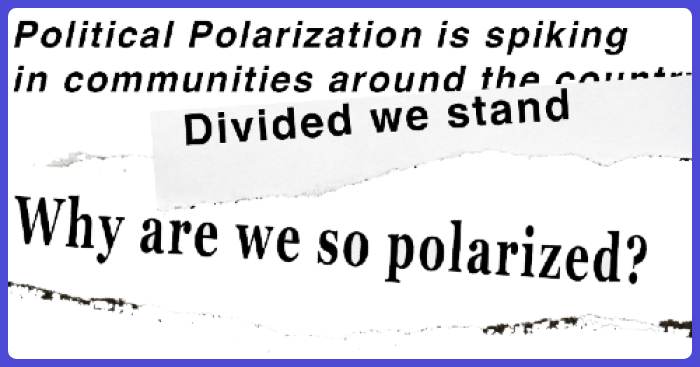
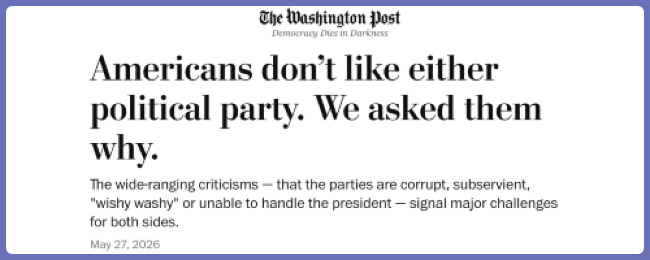
Every election cycle, the same headline reappears across the New York Times and other newspapers: America is more polarized than ever, and both parties are to blame. It sounds responsible and neutral, but it isn't either. It's a way to avoid holding one side accountable, and this polarized framing has done a terribly effective job of providing cover for the radicalized Republican Party.
Both-sidesing and polarization
I just came across the article, Polarization Is Not the Problem, an important piece by political scientist Lilliana Mason in the Journal of Democracy. You can read it here. Mason's argument is that polarization is not the disease, it's the immune response. The real conflict is in the undertow - we're in a decades-long fight: who gets to belong in our country? Who deserves equal protection under our laws? And who gets punished for stepping outside the social order in which only white, Christian, heterosexual men belong. Everyone else is on probation.
The old social order is changing - fast
Don't look now, but our demographics are changing. In just 40 years between 1979 and 2019, the white share of the American workforce fell from 88 percent to 78 percent. You've probably read that within 20 years or so, white people will be in the minority and People of Color will be a majority. The fear of this dramatic shift is triggering a massive and angry backlash, and I'm not even mentioning the 8 years of having a Black man as President.
When mainstream media names "polarization" as a problem, it ignores what the fight is actually about and it equalizes the two sides. The anti-democracy Republican Party wants to strip away rights and the pro-democracy Democratic Party side is refusing to give up those rights without a struggle.
When the NY Times runs a piece lamenting that "Americans can't talk to each other anymore," it doesn't ask who's being asked to give up what?
Mason's research reveals the asymmetry in hard numbers. In surveys fielded in 2017 and again in 2024, the share of Americans willing to call their political opponents "evil" rose from 40 percent to 70 percent, and the share willing to call them subhuman doubled, from 20 percent to 40 percent. Journalists usually report numbers like these as proof of a symmetrical problem, both sides getting angrier, both sides to blame. But Mason's data shows who is actually driving those numbers: the Republicans most likely to call Democrats evil or subhuman score high in racial resentment and sexism, while the Democrats most likely to call Republicans evil or subhuman score high in their opposition to racism and sexism. That's not two sides mirroring each other. It's one side defending an old hierarchy and another refusing to accept it.
Can't we just be civil?
Is there a comfortable middle ground between the fascist movement that's trying to restore Jim Crow via voter suppression, Christian nationalism, and replacement theory — and a pro-democracy movement that's trying to hold onto sixty years of gains for civil rights, women's rights and the right of your neighbors to not be disappeared?
Shannon McGregor, a media scholar at UNC's Hussman School of Journalism, put her finger on exactly why "polarization" is the wrong frame to begin with. As she put it in a recent conversation with The New Republic, "If we are solving for things like polarization, and there's two poles, that sort of makes it seem like the answer then is if both sides move together. But should we move together to reach consensus on whether people should have human and civil rights if they are trans or not white? That doesn't seem like the small-D democratic answer."
McGregor says that framing this as two poles in need of convergence isn't a neutral description of the problem. It's a choice to treat "should this group have rights?" as a negotiable midpoint rather than a settled question, and that choice is doing a lot of quiet work underneath every "can't we all just get along" op-ed.
Asking the pro-democracy side to meet halfway with people who want to destroy democracy would require the democracy side to disarm first. But it's clear by now that the radicalized Republican Party cannot be negotiated with, met halfway, it must be defeated at the ballot box and shown the door.
The two-party structure and original format for Congress are the main reasons why Republicans hold power disproportionate to their popularity. When mainstream media splits the difference down the middle, it hands the Republicans the cover story they need. Using the "polarization" label lets the NY Times, for example, avoid saying who is doing what to whom, that a radicalized Republican Party is cutting legal rights and norms.
The cost of that cover story isn't abstract. The Bridging Divides Initiative (link) found that local officials of color face violent threats at notably higher rates than their white counterparts, and as recently as late 2025, 68 percent of female local officials reported facing hostility on the job, compared with 52 percent of their male counterparts, with 83 percent saying they'd scaled back some political or civic activity as a result, including running for office or posting publicly about controversial issues. That's what gets filed under "division" when newsrooms reach for the polarization frame instead of naming who's living under threat and why.
Can we be civil with people who are okay with ICE?
Republicans are in favor of detaining, imprisoning, and deporting neighbors who have been part of their communities for decades. But let's sit down and have a coffee to meet in the political middle? Being consequential and holding people, and especially politicians accountable is a challenge and it's going to require a strong stomach and a straight spine. The work in front of us, building cultures of belonging inside our country, communities, and organizations is to refuse that false balance in our own language the same way we're asking newsrooms to refuse it in theirs.
Belonging isn't a neutral, both-sides conversation. It has a direction. It moves toward inclusion or away from it, and pretending otherwise is how, so far, the movement away from it keeps winning.
*Writer's note: yes, the Party that's being protected by framing polarization as a both-sides problem is the radicalized right-wing Republican Party.
Other articles, blogs and thoughts about both-sidesing and the vexing problem of polarization.
-- Follow Jeff Jarvis on Bluesky @jeffjarvis.bsky.social
-- Read this substack: The Problem With 'Both Sides' Journalism
-- Read this excellent substack, too! The Problem Is Right Wing Extremism, Not 'Polarization'
-- NYT Columnist Jamelle Bouie has an important take on polarization. "To talk about polarization is to take the view that there is a pox on both houses, that both sides are fundamentally responsible for the state of things." But don't take my word, watch the video.
Check it out! There are additional posts on the Culture of Belonging website.
Thank you for reading. I'd love to hear what you think - send an email by clicking reply or join the member discussion.