He Saw the DEI Rollback Coming. Then He Helped It Along.

SHRM's Johnny Taylor Is Not a Weatherman. He's a Gatekeeper.
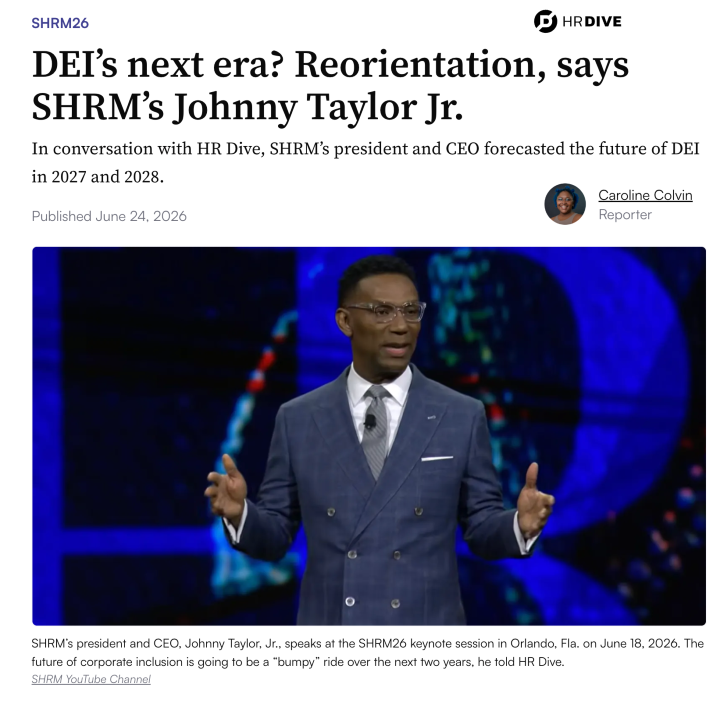
I just read an article in the magazine, HR Dive titled, DEI’s next era? Reorientation, says Johnny Taylor Jr., and had to write my take.
Taylor is the President and CEO of SHRM, the Society for Human Resource Management, the largest HR association in the world. At their annual conference, Taylor said that the future of DEI is "reorientation." Before I get into what he means by that, I want to lay out why he's not an innocent bystander observing trends. And he's certainly not displaying leadership for the thousands of members of SHRM. It's something else entirely. Stick with me, I'll finish this thought after laying out what he said!
The word reorientation deserves scrutiny. Reorientation away from what, exactly? Reorientation away from the people whose labor built this country without compensation. Away from the communities deliberately excluded from housing, wealth, education, and promotion by the very corporate structures SHRM serves?
About Johnny Taylor Jr.
From 2018 to 2021, Taylor served as chair of President Donald Trump's Advisory Board on Historically Black Colleges and Universities, in addition to serving on the White House American Workforce Policy Advisory Board. In 2024, Taylor was reportedly on Trump's short list for U.S. Secretary of Labor. Taylor said it would be "an honor" to be considered to lead the U.S. Department of Labor as part of the Trump administration.
That is not a neutral biography. That is a man whose institutional alignment with the most anti-equity, anti-worker administration in modern history is documented and on the record.
The "E" Was Not Unclear. It Was Intentional.
For years, SHRM was known for its work to support DEI education and training. They called it DE&I. Then, in a July 9, 2025 LinkedIn post, Taylor announced the organization's diversity initiative would now be called I&D, or inclusion and diversity. He dropped Equity. That's not just a brand change.
The stated reasoning was that people couldn't agree about what the "E" means. Dropping the E, Equity, is one of the most consequential linguistic retreats in the history of institutional HR. Equity is not ambiguous. Equity is the acknowledgment that identical treatment cannot produce just outcomes when the starting conditions are not identical. Removing equity from the banner of the nation's largest HR organization during a fascist assault on workplace protections is not pragmatism. It is capitulation dressed up as leadership.
Others, like Alex Suggs, co-founder of DEI consulting firm Different, warned that SHRM's stance could embolden more companies to back off DEI commitments. "They're in such a prominent position," Suggs told Axios. "If they are backing away from equity, that's giving a free pass to all the naysayers and giving more fuel to the fire of the backlash we're seeing."
The Robby Starbuck Decision Is Not Viewpoint Diversity
Then, in a clear confirmation of the direction SHRM was heading, Taylor moderated a stage panel featuring Robby Starbuck at the organization's Blueprint conference, which used to be named SHRM Inclusion.
Robby Starbuck is a far-right agitator who built his public profile and wealth by running pressure campaigns against corporate DEI programs and taking credit for their collapse, with no background in HR, organizational culture, or employment law.
Michael Baran, a longtime inclusion consultant, told HR Dive that SHRM's framing creates a false equivalency by suggesting there are two equally respectable sides in the debate over workplace equity. Other HR veterans questioned Starbuck's lack of corporate, business, or legal experience, noting that his public profile has been built more on incendiary activism than on expertise in organizational culture.
DEI strategist Felicia A. Henderson, who lectures at INSEAD Business School, said SHRM had been "abdicating its leadership in advancing corporate DEI," and that platforming Starbuck "may give an allure of legitimacy to Starbuck's ideas."
When the country's largest HR organization gives a platform to someone who treats equity as poison, it is not modeling viewpoint diversity. It is choosing a side.
"We Were Right" Is Not Accountability
Back in the HR Dive interview, Taylor said: "We were right. We told you in 2024 we'd be here today." That framing is doing something specific. It repositions SHRM's compliance with the Trump regime's attacks on DEI, especially on equity, as prescient leadership. Being right about the direction of an authoritarian tide doesn't make you a meteorologist. It makes you someone who saw the wave coming and wanted to ride the wave for personal gain and power. And telling everyone else they need to figure out how to swim.
Jamie Jackson, HR Brew contributor, noted the scale of SHRM's reach and influence: "We've looked to SHRM because they are the largest organization. When an organization like SHRM puts this out, you don't understand the repercussions and the ripples that come from that." She added it could have a particularly significant influence on one-person HR teams, who rely on SHRM to guide their decision making.
I've attended SHRM conferences. I've been an exhibitor on that floor. And what I saw there didn't look like an organization ready to retreat from equity. The exhibition hall was always filled with people from around the world, genuinely diverse, visibly creative, bringing teaching platforms, eLearning tools, games, puzzles, clothing, and a significant share of it was built specifically to advance DEI in the workplace. The energy in that space always told a story. But now, the decisions being made from the stage are telling a different one.
What This Means for Workers
The workers who bear the cost of this "reorientation" are not abstracted categories. They are Black women passed over for promotions in numbers that have not changed. They are trans workers newly vulnerable in workplaces that previously had explicit protections. They are disabled people whose accommodations are deprioritized the moment legal compliance becomes the only standard.
Taylor is right that Title VII does not use the word equity. He is right that the law is shifting in the direction of "reverse discrimination" claims. But law and justice are not the same thing. They have never been the same thing, and in this country, specifically, they have frequently been opposites.
SHRM's job should be to hold the profession to a higher standard than the law, not to shrink its commitments to fit whatever the current administration will tolerate.
What Taylor is calling a "reorientation" is a retreat. And a retreat by the most powerful HR organization in the world, led by a man who sought a cabinet role in the Trump administration, is not a weather forecast. It is a policy choice with real consequences for millions of workers who were already fighting upstream.
My perspective is that Taylor is not displaying leadership for the large and diverse organization. Instead, this is an executive using the language of practicality to reinforce the governing logic of racial hierarchy. Through his actions, Taylor is helping to erase equity-centered protections for people who have never had equal access to begin with.